Petrophysical Interpretation Report — 15-135-24,881-00-00
| Well (UWI) | 15-135-24,881-00-00 |
| Log date | Sat Feb 28 00-46-47 2009 |
| Service company | Log Tech |
| Acquisition date (header) | Sat Feb 28 00-46-47 2009 |
| PLSS location | Sec 12 T20S R22W (map precision ±1.6 km) |
| Larionov variant | old_rocks (degraded) |
| Convergence status | DID_NOT_CONVERGE |
| Confidence tier | ○ BRACKETED |
| Engine versions | calc_vsh 0.1.0 · calc_phie 0.1.0 · calc_sw 0.1.0 · formula_registry 0.1.0 |
| Config hash (SHA-256) | 2a9cb78728e386ab… |
| Git SHA | df574ffab7ee |
| Generated | autonomously, no human in the per-report loop |
Confidence legend. Each result is tagged by parameter provenance: ● FIRM (core-calibrated) · ◐ QUALIFIED (offset-derived) · ○ BRACKETED (regional/global default — read as a range, dominant uncertainty stated). The system does not claim *always correct*; it states how well-supported each number is.
1. Executive summary
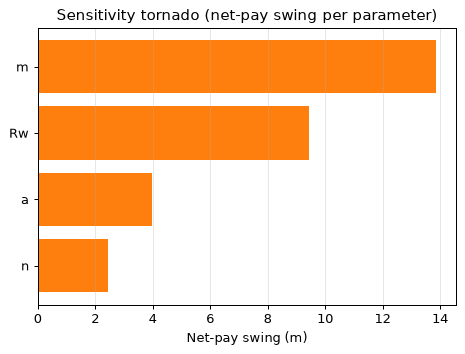
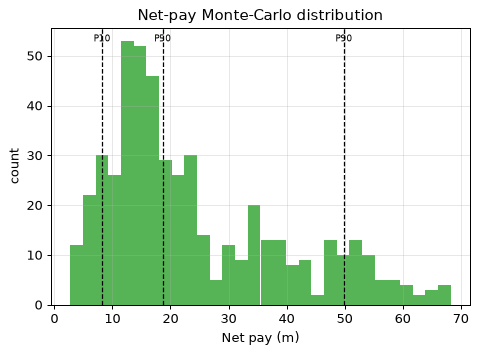
The pay assessment for well 15-135-24,881-00-00 remains bracketed rather than firm, with net pay spanning a wide 8.2 to 49.9 m range around a P50 of 18.7 m across the 200.0 m gross interval. The corresponding net-to-gross of 0.065 is low, though the net-pay rock itself carries reasonable properties — PHIE averaging 0.146, Sw near 0.379, and modest clay content at Vsh 0.114. This spread is driven chiefly by the cementation exponent m, which here is a regional default and uncalibrated in the absence of core; its 13.9 m swing means the wide P10–P90 envelope reflects genuine parameter uncertainty rather than a confident point estimate. A single validator objection was raised and the interpretation did not converge, so these figures should be read as ranges pending calibration.
Net pay P10 / P50 / P90 = 8.2 / 18.7 / 49.9 m.
Net pay is dominated by 'm', which is a regional DEFAULT (uncalibrated). This is the single largest uncertainty — the result is bracketed, not a confident point estimate.
2. Data inventory (from LAS)
- Curves present (canonical ← raw): DCAL←DCAL, DRHO←RHOC, GR←GR, NPHI←CNLS, PHID_SVC←DPOR, RHOB←RHOB, RMED←RILM, RT←RILD, RXO←RLL3, SP←SP
- Logged interval: 59.44–1382.57 m
- Log date: Sat Feb 28 00-46-47 2009
- Service company: Log Tech · Company: Berexco, Inc.
- Field: Schaben
- Not provided by LAS (out of scope): core, mud logs, pressure tests, production, completion, formation tops.
3. LAS quality control
| Edit type | Curve | Detail |
|---|---|---|
| unit_conversion | NPHI | factor 0.01 |
| hard_range_mask | RXO | count 1 |
| hard_range_mask | RT | count 117 |
| hard_range_mask | RMED | count 95 |
| hard_range_mask | RHOB | count 1 |
| hard_range_mask | DRHO | count 4 |
| hard_range_mask | PHID_SVC | count 5 |
| range_warn | GR | count 4 |
| range_warn | RHOB | count 4 |
| range_warn | NPHI | count 3 |
| spike_removal | — | 89 edits |
| degradation | — | 3 edits |
4. Standardization
Raw mnemonics mapped to canonical curve names:
| Canonical | Raw mnemonic |
|---|---|
| DCAL | DCAL |
| DRHO | RHOC |
| GR | GR |
| NPHI | CNLS |
| PHID_SVC | DPOR |
| RHOB | RHOB |
| RMED | RILM |
| RT | RILD |
| RXO | RLL3 |
| SP | SP |
Unit conversions: NPHI×0.01.
5. Per-curve log QC
- GR baseline: gr_p5=34.4, gr_p95=110.4
- Bad-hole: GOOD=0.844, DEGRADED=0.127, EXCLUDED=0.029
- Low-resistivity: rt_threshold=1.79, n_flagged=848, intervals=[[278.6, 282.2], [284.2, 339.1], [345.5, 346.7], [361.8, 362.4], [366.8, 367.1], [399.9, 401.7], [419.9, 421.8], [458.6, 458.7], [459.8, 467.4], [478.7, 480.2]]
6. Data preparation
Edits applied before compute (by type): degradation: 3, hard_range_mask: 6, range_warn: 3, spike_removal: 89, unit_conversion: 1.
7. Interval definition
- Logged interval: 59.44–1382.57 m
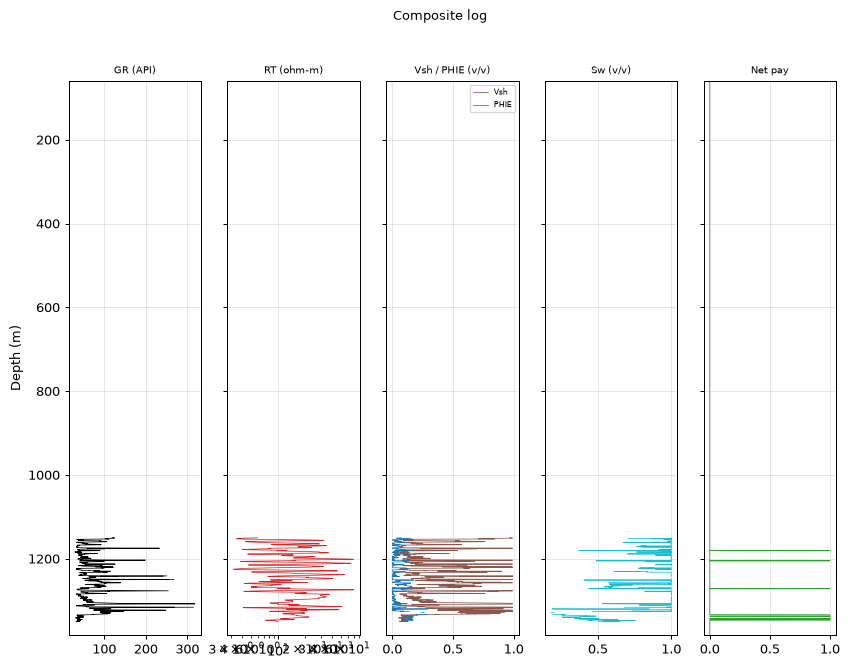
- Analysis window (analyst-restricted): 1150.0–1350.0 m — gross and NTG are measured over this window
- Gross evaluated interval: 200.0 m
- Computed net-pay runs (pre-merge): 7
- Zonation is computed by depth (no formation tops in LAS).
8. Methodology
All numbers are produced by the deterministic, golden-tested engine. The LLM only selects methods/parameters and writes prose — it never computes a number. Figures are deterministic renderings of these computed numbers for the human reader; the agent reasons over the numeric EDA digest, not images (the models have no vision).
| Step | Method (frozen) | Version |
|---|---|---|
| Vsh | Larionov 1969 (old rocks) | vsh_larionov_old 0.1.0 |
| PHIE | Density-neutron crossplot, shale-corrected | phie_density_neutron 0.1.0 |
| Sw | Archie 1942 | sw_archie 0.1.0 |
| Net pay | Vsh/PHIE/Sw cutoffs → net sand → net reservoir → net pay | netpay 0.1.0 |
| Uncertainty | Monte Carlo P10/P50/P90 + parameter sensitivity | mc 0.1.0 |
9. Gamma-ray analysis
- Clean baseline gr_min = 20.0 API · shale gr_max = 120.0 API
- Shale index IGR = (GR − gr_min)/(gr_max − gr_min), the basis for Vsh.
- GR baseline check: gr_p5=34.4, gr_p95=110.4
10. Resistivity analysis
Low-resistivity scan: rt_threshold=1.79, n_flagged=848, intervals=[[278.6, 282.2], [284.2, 339.1], [345.5, 346.7], [361.8, 362.4], [366.8, 367.1], [399.9, 401.7], [419.9, 421.8], [458.6, 458.7], [459.8, 467.4], [478.7, 480.2]].
Invasion profile (multi-depth resistivities, 8471 samples): fraction with shallow reading above deep (Rxo/RT > 1.2, invaded/permeable indication): 0.604; reversed (< 0.8): 0.098; median Rxo/RT 1.301; median Rmed/RT 0.961. Raw-curve facts; naming moveable hydrocarbon is the analyst's judgement.
11. Density-neutron crossplot lithology
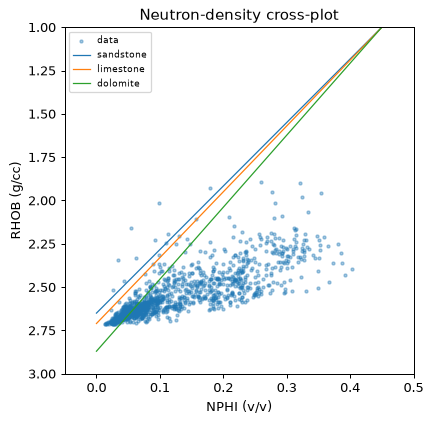
Matrix point-shares (fraction of points near each matrix line): sandstone: 0.091, limestone: 0.219, dolomite: 0.247. Engine crossplot output; naming the dominant lithology is the analyst's judgement. Comparison with core/mud log: not available (LAS-only).
12. Water resistivity (Rw)
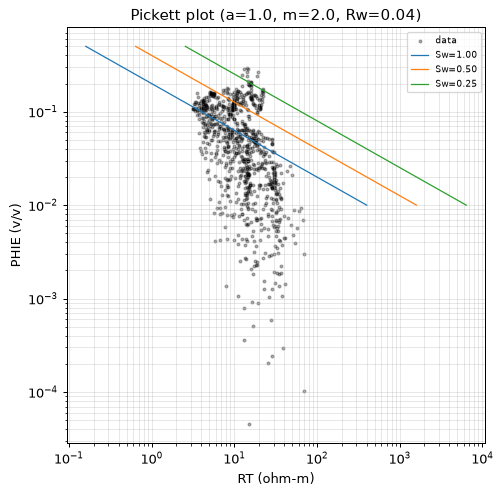
- Rw = 0.0400 ohm-m · provenance: default
- Sourced by the engine (Pickett / SP / default); never authored by the LLM.
- Net-pay sensitivity to Rw: 9.4 m swing.
13. Figures
Composite log
Pickett plot
Neutron-density crossplot
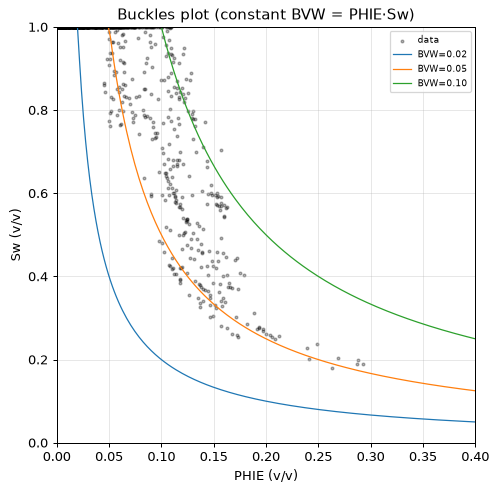
Buckles plot
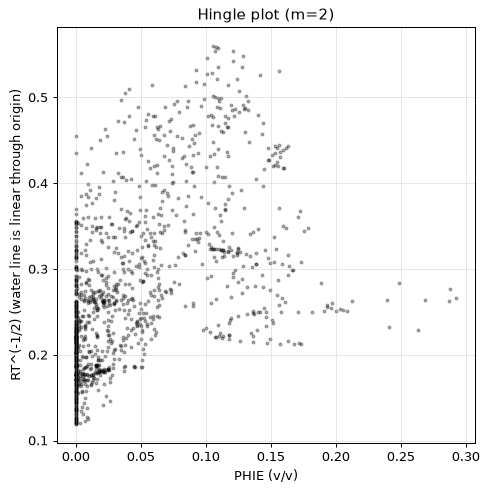
Hingle plot
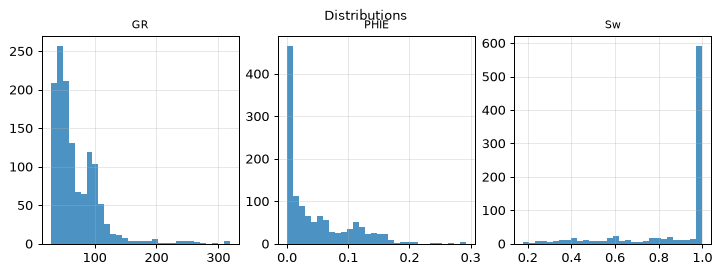
Distributions
Sensitivity tornado
Net-pay Monte-Carlo distribution
14. Shale volume (Vsh)
Mean Vsh by method (selection is the engine's; the LLM authors no number):
| Method | Mean Vsh | Selected |
|---|---|---|
| vsh_larionov_old | 0.344 | ✓ |
| vsh_larionov_tertiary | 0.271 | |
| vsh_linear | 0.460 | |
| vsh_clavier | 0.329 | |
| vsh_steiber | 0.292 | |
| vsh_neutron_density | 0.147 | |
| vsh_multimineral | 0.153 |
15. Derived parameters
- Bulk-volume water (BVW = PHIE*Sw): mean 0.0440 v/v
- Porosity-thickness (Phi·H over net pay): 1.895 m
- Hydrocarbon pore thickness (HCPV = Σ PHIE·(1−Sw)·step): 1.191 m
- Buckles constant (BVW at P10 of net pay): 0.0453 → Swirr (mean) ≈ 0.310 over 85 pay samples
16. Permeability (uncalibrated)
- perm_timur: mean k = 8.86 mD
_Uncalibrated screening estimate (no core); Sw used as the Swirr proxy._
17. Rock quality (uncalibrated)
- rqi: mean = 0.078
_Built on the uncalibrated permeability; indicative only._
18. Electrofacies
Unsupervised k-means on 1237 samples into 4 electrofacies (sample counts: facies 0: 368, facies 1: 287, facies 2: 192, facies 3: 390). Descriptive only — no core labels.
19. Parameters and provenance
| Parameter | Value | Unit | Provenance | Source |
|---|---|---|---|---|
| gr_min | 20.000 | API | default | — |
| gr_max | 120.000 | API | default | — |
| rho_ma | 2.710 | g/cc | default | Schlumberger 1989 |
| rho_fl | 1.000 | g/cc | default | — |
| phie_max | 0.450 | v/v | default | — |
| phi_sh_d | 0.100 | v/v | default | — |
| phi_sh_n | 0.350 | v/v | default | — |
| a | 1.000 | - | default | Winsauer et al. 1952 |
| m | 2.000 | - | default | Archie, G.E. 1942 |
| n | 2.000 | - | default | Archie, G.E. 1942 |
| Rw | 0.040 | ohm-m | default | Kansas Geological Survey 2000 |
| rt_hydrocarbon_floor | 5.000 | ohm-m | default | — |
| vsh_cutoff | 0.350 | v/v | default | — |
| phie_cutoff | 0.100 | v/v | default | — |
| sw_cutoff | 0.500 | v/v | default | — |
| bit_size_config | 7.875 | in | default | — |
| qc_abort_threshold | 0.800 | - | default | — |
| circuit_breaker_n | 3.000 | - | default | — |
The citations table (not RAG) gives each cited parameter exactly one frozen source. Parameters tagged
defaultare regional/global — they drive the bracketed tier.
20. Petrophysical cutoffs
Boundary-inclusive criteria applied by the engine (netpay) to flag reservoir:
| Stage | Criterion | Cutoff | Provenance |
|---|---|---|---|
| Net sand | Vsh ≤ cutoff | 0.350 | default |
| Net reservoir | + PHIE ≥ cutoff | 0.100 | default |
| Net pay | + Sw ≤ cutoff | 0.500 | default |
Cutoff values are engine parameters (never LLM-authored); the dominant net-pay uncertainty is m — see Uncertainty for the swing.
21. Data quality and validator objections
Curve provenance (canonical ← raw mnemonic): DCAL←DCAL, DRHO←RHOC, GR←GR, NPHI←CNLS, PHID_SVC←DPOR, RHOB←RHOB, RMED←RILM, RT←RILD, RXO←RLL3, SP←SP.
QC edits applied before compute — degradation: 3, hard_range_mask: 6, range_warn: 3, spike_removal: 89, unit_conversion: 1.
| Validator | Type | Detail |
|---|---|---|
| vsh_phie_anticorrelation | support | Vsh-PHIE Pearson 0.97 > 0.3 (dirty rock + high porosity) |
22. Methodology (decision graph)
flowchart TD
    dec_1["decision: step: review_attempts"]
    act_1["tool_call: review_attempts"]
    dec_2["decision: DETERMINISTIC DEFAULT (model empty): compute_vsh"]
    act_2["tool_call: compute_vsh"]
    dec_3["decision: step: crossplot"]
    act_3["tool_call: crossplot"]
    dec_4["decision: step: interval_stats"]
    act_4["tool_call: interval_stats"]
    dec_5["decision: step: set_zone_of_interest"]
    act_5["tool_call: set_zone_of_interest"]
    dec_6["decision: step: validate_choice"]
    act_6["tool_call: validate_choice"]
    dec_7["decision: step: lithology"]
    act_7["tool_call: lithology"]
    dec_8["decision: step: derived_parameters"]
    act_8["tool_call: derived_parameters"]
    dec_9["decision: step: permeability"]
    act_9["tool_call: permeability"]
    dec_10["decision: wasted no-op: permeability"]
    dec_11["decision: step: rock_quality"]
    act_10["tool_call: rock_quality"]
    dec_12["decision: step: electrofacies"]
    act_11["tool_call: electrofacies"]
    dec_13["decision: wasted no-op: lithology"]
    dec_14["decision: wasted no-op: permeability"]
    dec_15["decision: wasted no-op: rock_quality"]
    dec_16["decision: wasted no-op: lithology"]
    dec_17["decision: wasted no-op: permeability"]
    dec_18["decision: wasted no-op: lithology"]
    dec_19["decision: wasted no-op: permeability"]
    dec_20["decision: wasted no-op: rock_quality"]
    dec_21["decision: wasted no-op: permeability"]
    dec_22["decision: wasted no-op: rock_quality"]
    dec_23["decision: wasted no-op: permeability"]
    dec_24["decision: wasted no-op: lithology"]
    dec_25["decision: wasted no-op: permeability"]
    dec_26["decision: step: compare_methods"]
    act_12["tool_call: compare_methods"]
    dec_27["decision: wasted no-op: permeability"]
    dec_28["decision: wasted no-op: lithology"]
    dec_29["decision: wasted no-op: permeability"]
    dec_30["decision: wasted no-op: lithology"]
    dec_31["decision: wasted no-op: permeability"]
23. Data gaps for calibration
This is a LAS-only study. Data that would calibrate the interpretation is absent:
- Core (routine + SCAL): would anchor PHIE and Archie m, n, a.
- Pressure tests (RFT/MDT): would give true fluid contacts and gradients (log-based).
- Production/flow data: would test the net-pay flag against deliverability.
- Dominant net-pay uncertainty driver (from the sensitivity): m (calibrated by core SCAL — cementation exponent m).
- Standard curves absent: DT, PEF, CALI.
24. Limitations
- LAS-only study: no core calibration, no pressure tests (no true fluid contacts), no production, no mud logs, no formation tops (zonation computed by depth).
- Standard curves absent in this well: DT, PEF, CALI.
- Results are uncalibrated; accuracy depends on data not provided.
25. Conclusions
This interpretation is bracketed, not firm: it did not converge, one validator objection stands, and the net-pay result should be carried as a range — P10/P50/P90 of 8.2/18.7/49.9 m across the 200.0 m gross interval — rather than as a single number. The net-to-gross of 0.065 is low, but where net pay is counted the rock reads cleanly, with PHIE of 0.146, Sw of 0.379, and Vsh of 0.114. The dominant control on the outcome is the cementation exponent m, applied here as an uncalibrated regional default and accounting for a 13.9 m swing in net pay; it is the single largest source of uncertainty. The most direct way to narrow this range is core calibration of m. Until that calibration exists, these numbers should guide decisions only as a bracketed envelope, not as firm estimates.
Appendix A — Ledger excerpt (traceability)
{
  "net_pay_total_m": 12.954000000000008,
  "net_pay_p10_p50_p90": [
    8.229600000000005,
    18.66900000000001,
    49.88052000000004
  ],
  "driving_params": {
    "a": 1.0,
    "m": 2.0,
    "n": 2.0,
    "Rw": 0.04
  },
  "claim_verifier": {
    "result": "PASS",
    "flags": [],
    "tone_flags": []
  }
}
Appendix B — Completeness gate
| Item | Present |
|---|---|
| QC edits recorded before compute | ✓ |
| Every number ledger-traced | ✓ |
| Confidence tier on the run | ✓ |
| Parameter citations frozen | ✓ |
| Validator objections listed, not hidden | ✓ |
| Uncertainty propagated (Monte Carlo) | ✓ |
| Claim verifier run on prose | ✓ |